
Select shipping country

In order to provide you with the final prices of the products (including taxes and transport costs), we need you to select the country of destination from the following list of countries.

On 1 July 2021 the One-Stop Shop (OSS) directive for e-commerce came into force. This will require us to apply the V.A.T. rate corresponding to the destination country of the shipment.

Shopping cart
Your shopping cart is empty!

Buy ORGANIC MIXED BOXES

Organic Mixed Box 10 kg (5 kg oranges + 5 kg mandarins)
BIO
10.0 kg

Organic Mixed Box 10 kg (5 kg oranges + 5 kg mandarins)

València Late/Murcott
39.00 3.90 €/kg
Out Of Stock
Organic Mixed Box 15 kg (10 kg oranges + 5 kg mandarins)
BIO
15.0 kg

Organic Mixed Box 15 kg (10 kg oranges + 5 kg mandarins)

València Late/Murcott
45.50 3.03 €/kg
Out Of Stock
Organic Mixed Box 20 kg (10 kg oranges + 10 kg mandarins)
BIO
20.0 kg

Organic Mixed Box 20 kg (10 kg oranges + 10 kg mandarins)

València Late/Murcott
55.50 2.78 €/kg
Out Of Stock
Organic Mixed Box 20 kg (15 kg oranges + 5 kg mandarins)
BIO
20.0 kg

Organic Mixed Box 20 kg (15 kg oranges + 5 kg mandarins)

València Late/Murcott
53.50 2.68 €/kg
Out Of Stock

Oranges València Late

Origin

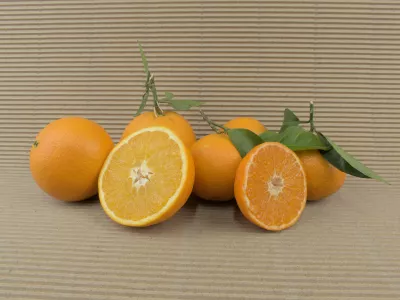
The Valencia Late orange variety has an uncertain origin, although it is believed to come from Portugal, where it appeared a long time ago. Initially, it received names such as Excelsior, Rivers Late, Hart Late, or Hart's Tardif, until it was named Valencia Late in 1987. It was introduced in Spain by the Naranjera de Levante Station and began to spread widely in the first half of the 20th century. In the 1977-1978 campaign, it surpassed the Berna variety in production, becoming the most cultivated late orange variety in Spain. In 1966, the Late Frost variety, of nuclear origin, was imported from California and began to be commercially disseminated.

Characteristics

The Valencia Late tree is vigorous and thornless. It has low viable pollen and is self-compatible. The fruit is medium-sized, weighing between 170 and 220 grams, with a diameter of 64 to 80 mm. It is round in shape, with a diameter/height ratio of 1.01. The rind is a bright orange color, with a color index of 10, and a thickness of 2.7 to 3.7 mm. The pulp is juicy, with a juice content that varies between 53% and 58%. The number of seeds per fruit is low, generally between 1 and 4. The flavor is balanced, with a notable sweetness and a slight acidity.

Harvesting period

The harvesting of Valencia Late in the Comunitat Valenciana takes place between March 20 and June 15. This variety holds well on the tree, allowing for harvesting until summer without losing quality. Its optimal fresh marketing window spans from late March to mid-June.

Culinary uses

Valencia Late is suitable for both fresh consumption and industry. Its high juice content and balanced flavor profile make it ideal for the production of natural juices. Additionally, its juicy pulp and slightly acidic flavor make it an excellent option for direct consumption as table fruit.

Agronomic notes

Valencia Late is a productive variety, although it shows a slight tendency to alternate harvests. It is somewhat sensitive to greening. It adapts well to all citrus-growing areas, although it is especially recommended in those where the risks of late frosts are not very high. The fruit has good conservation on the tree, although at the end of the harvesting period, the neck of the fruit may turn green. Its post-harvest behavior is favorable, allowing for storage in chambers for summer consumption.

Mandarins Murcott

Murcott Mandarin

OVERVIEW:
The fruits are small, flattened, and have a bright reddish color, less intense towards the end of their ripening. Easy to peel with tender, melting flesh, rich in juice, and with a characteristic slightly acidic taste. Like most mandarins, it usually has no seeds, unless there is cross-pollination by bees with other varieties. It is a patented variety highly appreciated for its flavor. After harvest, it can last up to 20 days in a cool, dry place without direct sunlight. Its harvest time is between February and March.

SIZE:
This variety is small. The smallest size marketed for fresh oranges delivered to your door is 50 mm for this variety.

DURABILITY:
They remain in good condition for up to 20 days after harvest (some fruits even longer) if our storage recommendations are followed: Remove them immediately from the box, spread them out on a large surface, protected from extreme temperatures and humidity, away from direct sunlight and heat sources, and separate any fruit that may be spoiling. These measures must always be followed, as it must be remembered that these are perishable products that have not been treated after harvest, so it is even possible that some fruits will spoil before 20 days.

POSSIBLE INCONVENIENCES:
It may have aesthetic defects, but these do not affect its quality (see our blog on this topic). In the advanced state of ripeness, it may be soft and change flavor.

Organic Farming

These fruits come from a certified organic farming that respects the environment. Treatments are only applied when necessary and always with natural substances approved by the organic agriculture committee. Like all our products, they undergo no post-harvest treatment.

Different regional control bodies in Europe ensure that consumers receive truly organic products. The organization for our region is CAECV (Committee of Organic Agriculture of the Valencian Community), authorized by the European Union with code ES-ECO-020-CV.