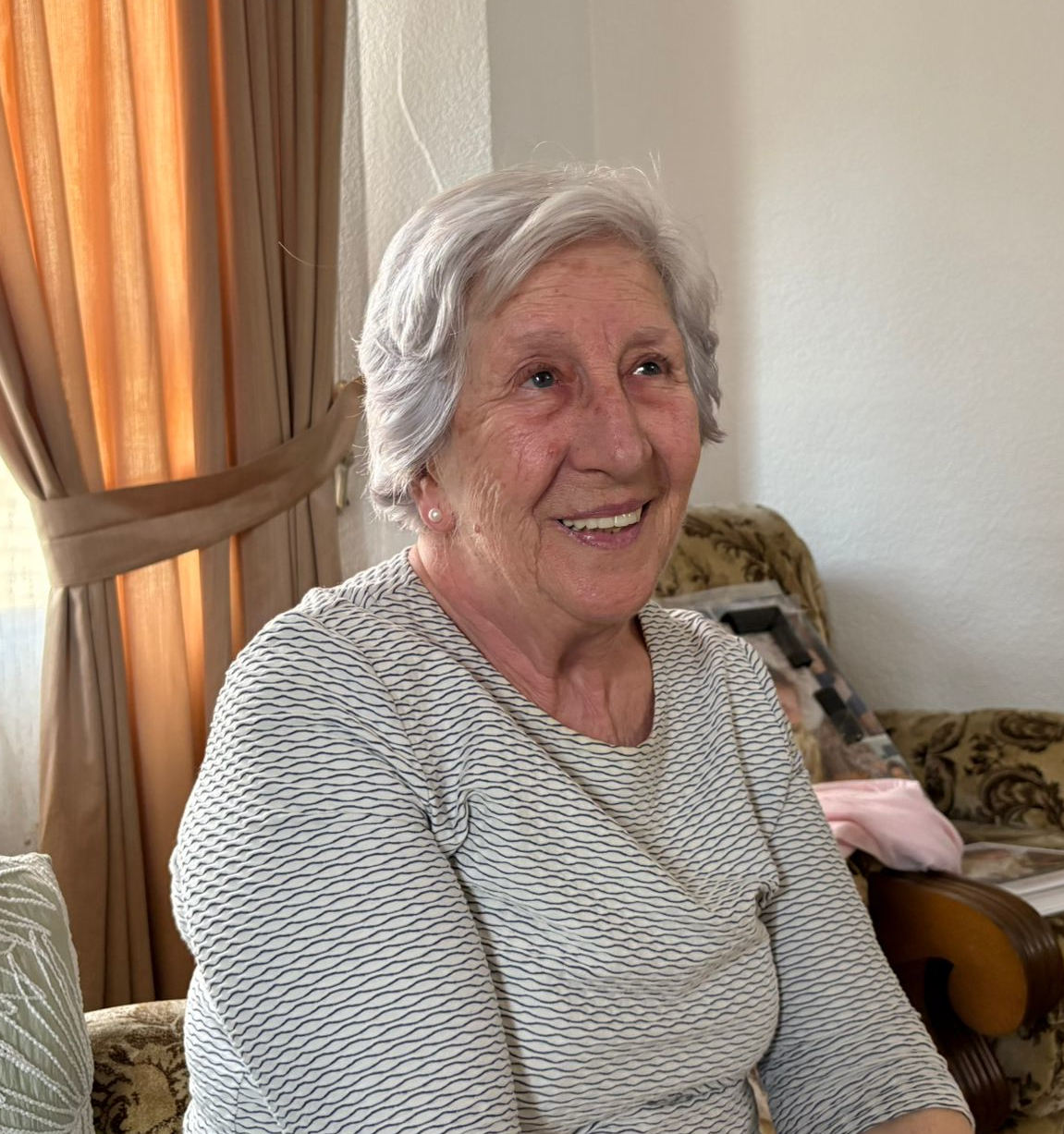
Mari: from the office to the field, a story of resilience
At the age of 52, Mari was forced to leave behind her career as an office administrator to start a new professional chapter in the world of agriculture — a change she never could have imagined after decades devoted to a completely different line of work.
Sixteen years ago, Mari received the news that her husband, a grower and farmer who managed several orange groves, was ill. Faced with this situation, she decided to leave her job as an administrator at a property agency to help him with the orange groves, which at the time operated as a conventional nursery. Until then, her contact with that world had been limited to spending Sundays in the fields with her family.
I've always enjoyed going to see the groves with my daughters and my husband, but I never would have imagined that I'd have to take charge of them myself.
When her husband passed away, Mari decided to wind down the entire nursery and continue looking after the groves out of respect for what her husband had left their daughters — their inheritance — and to carry on building what he had worked so hard to create over so many years, without letting all that effort go to waste.
She rolled up her sleeves and began learning everything from scratch. As she tells it, at first she felt completely out of her depth, as she neither understood nor knew that world. It was tough. She started by going through the invoices for the products her husband used to buy, since she had handled the accounts when he was still in charge of the groves and the nursery. She studied what type of fertiliser he used depending on the time of year and, when they were still practising conventional farming, she learnt that you cannot always use the same one because the soil gets used to it and stops absorbing it properly. Mari gets emotional recounting how she gradually learnt to manage the groves with the help of cooperatives and agricultural advisors, who guided her on which products to use, in what quantities and when to apply them.
Over time, she had to give up some groves and plots on the advice of her daughters, who made her realise she was working far too hard for virtually no return. What she earned from some plots had to be reinvested in others, and on top of that she had to cover all the labour costs. In the end there was nothing left and, on occasion, she even had to dig into her own pocket. That is why she decided to reduce the area she farmed so she could carry on with a better quality of work, leaving some groves behind.
From conventional to organic
Although her husband had never taken the plunge into organic farming — even though she had already begun to consider it — because he felt it would be too much work and that the groves were not ready for such a change, Mari decided a few years later to take the step and take the risk.
The conversion to organic farming was mainly driven by her daughters: the eldest, a PhD in Biological Sciences specialising in parasites, who had been encouraging her for years to make the switch as it would be more profitable and rewarding, and the youngest, a therapist specialising in brain injury. She had to complete several courses in order to carry out this transformation. As she immersed herself in this world, she realised it offered her a new motivation, a different way of treating things and understanding ecosystems.
The shift from conventional to organic farming means allowing the trees to follow their natural cycle more closely and avoiding the use of products that, during their growth, are harmful to the environment or to people.
Mari says the switch to organic farming has made her far more aware of making the most of plant material, recycling and reusing green waste to produce compost. The move to organic farming meant much more effort and sacrifice, but despite the difficulty, it has been a truly motivating experience.
Today
Today, although she is now retired, she remains in charge of the groves, as renting or selling them is simply not an option for her. She is the one who keeps an eye on everything running smoothly: the workers, the products and the overall condition of the fields.
Drawing on her experience, she reflects on society's lack of awareness about climate change, as the effects of drought are devastating and hard to imagine until you witness them first-hand through farming. This reality has deepened her environmental awareness.
For Mari, farming is a beautiful endeavour, yet profoundly vulnerable, as it depends not only on human effort but on external factors such as the weather, making it an activity as valuable as it is fragile.