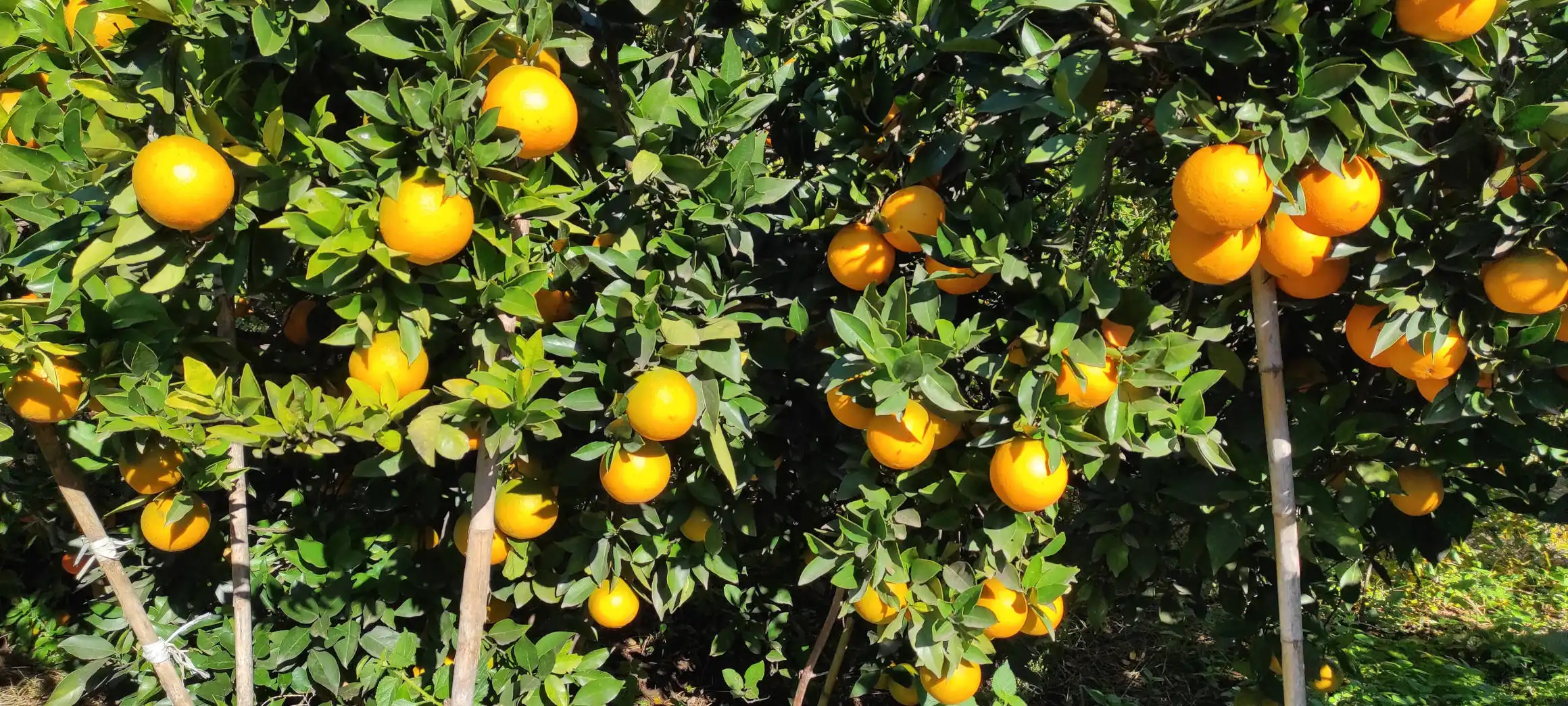
Buying oranges directly from the grower: a guide to getting it right
Buying oranges directly from the grower has become a phrase used by almost everyone selling oranges online. Some of them are growers; others buy the fruit at a warehouse and forward it. We wrote this guide from a farm in Cullera (Valencia) that has sold its own harvest online since 2011, with one aim: that you know what you are buying, from whom, and how to check it, whether you buy from us or from someone else.
What buying directly from the grower means (and what it does not)
It means the person who picks the orange from the tree is the person who sells it to you: no packing house, no cold storage, no middleman buying in bulk to resell. In practice, three things change:
- The fruit is picked when you order it. We harvest on the same day your box ships. There is no stock waiting, which is why the shop says "back in November" when a fruit is not on the tree.
- No post-harvest treatments. Supermarket oranges are degreened, waxed and treated with fungicides so they survive weeks in cold storage and on the shelf. Ours go from the tree to the box: no wax, no treatments after picking.
- The price stays with the person who grows. In the long chain the grower gets a fraction of what you pay in the shop. In the short chain, the price per kilo pays for the orchard, the picking and the transport, and little else.
What it does not mean: that every piece of fruit comes from a single field. In our case most of it comes from our own orchards and, when demand exceeds the harvest, we top up with neighbouring growers in Cullera and La Ribera who farm the same way and also pick to order. We say so because it is the question almost nobody answers.
Real advantages (without exaggerating)
- Freshness you can see in the peel and taste in the juice. An orange picked two days ago has nothing in common with one that has spent three weeks between cold storage, transport and the shelf. At home it keeps longer, not shorter: we explain it in how long our citrus keeps and how to store it.
- Untreated peel. If you use the zest in the kitchen, it matters. Our oranges, conventional and organic, carry no wax and no post-harvest fungicides.
- You know where it comes from. Town, family, variety and picking date. If a website tells you none of the four, be suspicious.
- Ripened on the tree. We pick when the fruit has sugar, not when the commercial calendar says so. That is why each variety has its window and we do not sell outside it.
What we will not promise: that it is cheaper than supermarket oranges on offer, or that every piece is the same size. It is freshly picked fruit, not fruit graded on an industrial line.
How to tell a grower from a middleman: six checks
- Do they say where the farm is and who works it? A town, some names, their own photos. "Oranges from Valencia" on its own is not a farm, it is a region.
- Do they pick to order or hold stock? If they can ship any quantity at any time of year, there is a warehouse and a cold room behind it.
- Do they respect the season? A grower tells you the orange is back in November and the blood orange in February. A middleman has everything all the time.
- Do they tell you which variety they are sending? And if it changes mid-season, they say so. Fruit is not a brand: it is Navelina in November and something else in April.
- Do the reviews have a name, a date and text? Google reviews are hard to fake. Ours are in what our customers say.
- Does the organic fruit carry a certificate number? "Natural farming" or "chemical-free" is not organic. Organic means a registered, audited operator: ours is ES-ECO-020-CV, from the Valencian organic farming committee (CAECV). You can read how we do it in our organic project.
Which orange is available each month
The Valencian citrus season runs from October to June, but not every fruit is available the whole time. This is ours, broadly; the exact dates are set by each year's ripening and we publish them in our variety calendar.
- Mandarins: October to April, starting with the early clementines.
- Oranges: November to June. Navelina opens the season (for eating and juicing, seedless) and later varieties follow through to late spring.
- Organic oranges: November to May, with the same succession of varieties.
- Lemons: November to May.
- Blood oranges: a few weeks between February and March.
- Avocados: February to May.
- El Perelló tomatoes: May and June, when the oranges are almost gone.
If you want a fruit that is not on the tree yet, you can leave your email under "Notify me" in each category and we will write to you the day we pick it.
What it costs to buy oranges from the grower
What usually surprises people is that the price includes delivery: there is no cheap box and expensive shipping. The current price per box and per kilo is on each product page, for your country.
There are also 5 kg and 15 kg boxes, and mixed boxes to combine oranges, mandarins and lemons in one delivery. The bigger the box, the cheaper the kilo, because transport weighs less in the total. If it sounds like a lot of fruit, first check how long it keeps: 20 kg of freshly picked oranges last longer at home than you think.
Our farm in Cullera
We are Ruth and Ximo. In 2011 we started selling online the harvest of the orchard that Joaquín, Ximo's father, had worked all his life selling to middlemen. The orchard is in Cullera, inside the Albufera Natural Park, and since then we have been moving part of the fields to certified organic farming. You can read the whole story in about us, see the fields in the gallery and read what customers say in reviews.
Frequently asked questions
How long does delivery take?
It depends on the country: 24-48 hours in Spain, 2-3 working days in France, 3-4 in Germany and Austria. We pick on the day of shipping, so the fruit you open has been off the tree for two or three days, not weeks.
Is there a minimum order?
The smallest box is 5 kg. Delivery is included in all of them.
Can I mix oranges and mandarins?
Yes, with the mixed boxes. And if you fancy a fruit that is out of season, use "Notify me" in its category and we will write to you when it is back.
What if a piece arrives damaged?
Write to us with a photo and we will sort it out. It is fresh fruit and transport sometimes treats it badly; you do not have to keep a box that is not right.
Are the organic oranges certified?
Yes, operator ES-ECO-020-CV (CAECV). The number appears on the box and on every organic product page.
Can I collect the fruit in person?
Yes, in Cullera and in Favara, choosing collection when you order: no delivery cost, and the fruit is picked from the tree for you just as if we were shipping it.
If you want to try them: Valencia oranges or organic oranges, picked on the day of shipping and at your door a few days later.