- Conventional season
- Varieties
- Today (28 oct)
We usually start harvesting in November, depending on ripeness.
Approximate dates: they shift from year to year with the weather. We start each variety when flavour, acidity and juice convince us, and we pull it when they no longer do. Season calendar
-
 Next to arrive
Navelina
Harvest approx. 7 nov → 7 feb
The first orange of the season and the one that stays with us longest. Large, easy to peel and very sweet; as good for juice as for eating.
- Sweetness
- Acidity
- Juiciness
- Peeling ease
- Juice % 50–54 %
- 200–220 g
Full profile of Navelina
The Navelina variety is a spontaneous mutation of the Washington Navel orange originating in Riverside (California) around 1910, initially known as Smith’s Early Navel. In 1933 it was sent as plant material to the IVIA in the Valencian Community, where it was given the name Navelina because of its slightly smaller size than Washington Navel. Its commercial propagation began in the 1960s, with significant expansion during the 1970s, establishing itself as one of the most widely cultivated Navel varieties in Spain.
Characteristics
Vigorous tree, rather compact in habit, thornless and with dark-colored foliage. It presents pollen-free flowers, typical of the Navel group. The fruit is round, slightly oblate, with a diameter between 73-78 mm, and a diameter/height ratio close to 0.98. Average weight ranges between 200-220 g. Medium-thickness peel (3.5-4.5 mm), intense orange color, color index 18. Very juicy pulp, seedless, with a typical number of segments between 10-12. As for internal quality, the Brix degrees are around 10-12º, with moderate acidity (around 0.9-1.0 % citric acid), juice content between 50-54 % of the fruit.
Harvest period
In the Valencian Community, harvesting begins approximately between October 20 and 30 and extends until the end of January. It is early-ripening compared to other Navel varieties, reaching the market earlier. It has a good ability to remain on the tree without losing quality during the first half of the harvest window; its optimal fresh-market window is in November and December, when it reaches its maximum internal quality and external color.
Culinary uses
It is mainly intended for fresh consumption, as a table orange, due to its ease of peeling, sweet flavor and seedless pulp. It can also be used for juice, although it is not its preferred use for the industry, since other varieties provide higher juice yield. In Mediterranean cuisine it is enjoyed as is, in fruit salads, salads or side dishes where its citrus aroma is appreciated; combinations with honey, fresh herbs (mint, thyme) or mild cheese are common.
Agronomic notes
High productivity and early bearing. It shows alternation between seasons, although moderate. Good tolerance to calcareous soils and iron chlorosis, and also some resistance to cold compared with other Navel varieties. Sensitive to rind blemish; peduncle attachment is good. It is recommended to graft onto rootstocks such as Carrizo citrange or C-35, which provide a good balance between vigor and fruit quality. Postharvest behavior is good if it is kept at temperatures between 6-8 °C; there are limitations in prolonged storage, since the flavor may change and delayed bitterness appears if the juice is used after a long storage period.
-
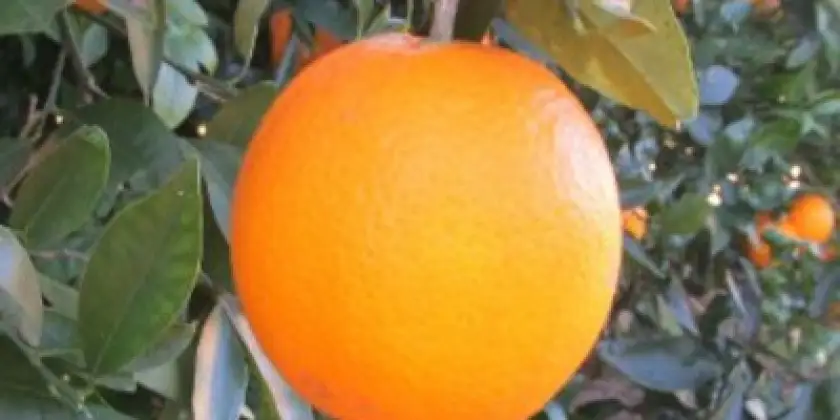
Lanelate
Harvest approx. 5 feb → 10 may
A late Navel that takes over from Navelina in early February. Very sweet and extremely juicy; past its peak it does not change flavour.
Full profile of Lanelate
General description
Also known as Navel-Lane. Late orange of the Navel family, medium size and rounded shape, smooth skin of little thickness and orange-yellow color. Its navel is more discreet than that of other Navel varieties. With an excellent and very sweet flavor, it produces a large amount of juice and does not have seeds, being suitable both for juice and for table orange. Unlike other varieties, past its optimal ripening point it does not change its flavor.
Caliber
The average caliber of this variety is medium size: the vast majority of pieces are above 75 mm. The minimum commercial caliber in Naranjas de Cullera for this variety is 67 mm.
Durability
It is kept in good condition up to 30 days after harvest (some pieces even more), always following our instructions for its conservation: remove them immediately from the box, spread them on a large surface, with temperature and humidity not extreme, without direct sunlight or heat sources, and discarding any piece that may spoil. This is a general rule, taking into account that they are perishable and without post-harvest treatments, it is also possible that some piece will spoil before 30 days.
Possible inconveniences
It may present aesthetic defects that do not affect its quality (see our blog in this regard). In advanced stages of its ripening it can be soft. Like all fresh oranges without post-harvest treatments, they do not peel completely well by hand.
-
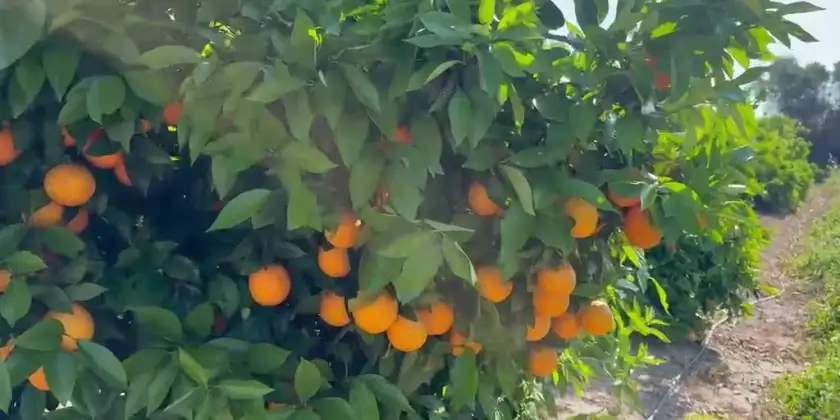
Barberina
Harvest approx. 28 apr → 29 may
A mutation of València Late that closes our season in May: sweet and low in acidity. Its juice does not turn bitter even if left to stand.
- Sweetness
- Acidity
- Juiciness
- Peeling ease
- Juice % 50–55 %
- 190–230 g
- Shelf life 30 days
Full profile of Barberina
The Barberina orange is a spontaneous mutation of the Valencia Late variety, discovered in 1982 in Rafelcofer, Valencia, by Vicente Barber. This variety is characterized by its late ripening and high organoleptic quality.
Characteristics
The Barberina tree has a vigorous and compact growth habit, with large, dark green leaves and wood that is darker than that of the Valencia Late. The fruit is large, round to slightly elongated, seedless and without a navel. The skin is medium thickness, uniformly orange in color and has a waxy appearance. The pulp is juicy, with a high juice content (50-55%), sweet flavor and low acidity, making it ideal for fresh consumption and juice.
Harvesting season
The harvesting of Barberina in the Comunitat Valenciana takes place from early May until July. The fruits can remain on the tree for several months without losing quality, allowing for an extended window of fresh marketing.
Culinary uses
The Barberina orange is suitable for both fresh consumption and juice production, thanks to its high juice content and balanced flavor. Its juice does not become bitter after squeezing, making it ideal for fresh juices. It is also suitable for the food industry in the production of juices and other derived products.
Agronomic notes
The Barberina is a productive variety, with high-quality fruits that can remain on the tree without deterioration. It has lower acidity than the Valencia Late, which makes it sweeter. It is resistant to fruit drop due to its robust peduncle. Its cultivation is recommended on Citrange rootstocks for optimal development. In post-harvest, the fruits can be stored in cold, although excessively low temperatures can cause cold damage.
-
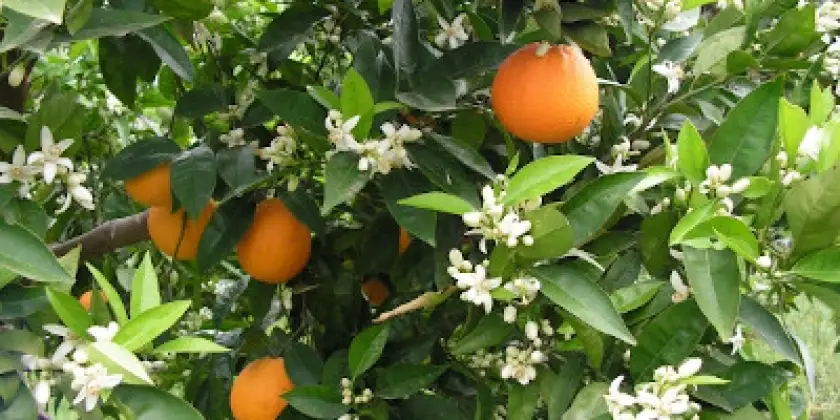
València Late
Harvest approx. 4 may → 3 jun
The latest orange in Valencia, Spain, with no navel and firm flesh. Very juicy, a touch more acidic than Lanelate; may contain the odd seed.
- Sweetness
- Acidity
- Juiciness
- Peeling ease
- Juice % 53–58 %
- 170–220 g
Full profile of València Late
The Valencia Late orange variety has an uncertain origin, although it is believed to come from Portugal, where it appeared a long time ago. Initially, it received names such as Excelsior, Rivers Late, Hart Late, or Hart's Tardif, until it was named Valencia Late in 1987. It was introduced in Spain by the Naranjera de Levante Station and began to spread widely in the first half of the 20th century. In the 1977-1978 campaign, it surpassed the Berna variety in production, becoming the most cultivated late orange variety in Spain. In 1966, the Late Frost variety, of nuclear origin, was imported from California and began to be commercially disseminated.
Characteristics
The Valencia Late tree is vigorous and thornless. It has low viable pollen and is self-compatible. The fruit is medium-sized, weighing between 170 and 220 grams, with a diameter of 64 to 80 mm. It is round in shape, with a diameter/height ratio of 1.01. The rind is a bright orange color, with a color index of 10, and a thickness of 2.7 to 3.7 mm. The pulp is juicy, with a juice content that varies between 53% and 58%. The number of seeds per fruit is low, generally between 1 and 4. The flavor is balanced, with a notable sweetness and a slight acidity.
Harvesting period
The harvesting of Valencia Late in the Comunitat Valenciana takes place between March 20 and June 15. This variety holds well on the tree, allowing for harvesting until summer without losing quality. Its optimal fresh marketing window spans from late March to mid-June.
Culinary uses
Valencia Late is suitable for both fresh consumption and industry. Its high juice content and balanced flavor profile make it ideal for the production of natural juices. Additionally, its juicy pulp and slightly acidic flavor make it an excellent option for direct consumption as table fruit.
Agronomic notes
Valencia Late is a productive variety, although it shows a slight tendency to alternate harvests. It is somewhat sensitive to greening. It adapts well to all citrus-growing areas, although it is especially recommended in those where the risks of late frosts are not very high. The fruit has good conservation on the tree, although at the end of the harvesting period, the neck of the fruit may turn green. Its post-harvest behavior is favorable, allowing for storage in chambers for summer consumption.