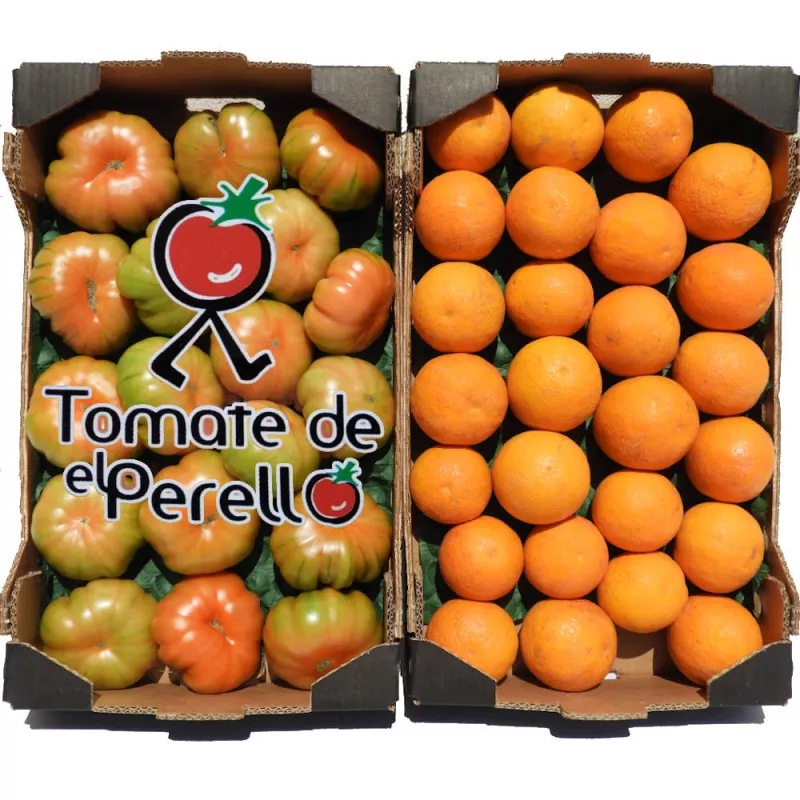
Oranges Navelina
Origin
The Navelina variety is a spontaneous mutation of the Washington Navel orange originating in Riverside (California) around 1910, initially known as Smith’s Early Navel. In 1933 it was sent as plant material to the IVIA in the Valencian Community, where it was given the name Navelina because of its slightly smaller size than Washington Navel. Its commercial propagation began in the 1960s, with significant expansion during the 1970s, establishing itself as one of the most widely cultivated Navel varieties in Spain.
Characteristics
Vigorous tree, rather compact in habit, thornless and with dark-colored foliage. It presents pollen-free flowers, typical of the Navel group. The fruit is round, slightly oblate, with a diameter between 73-78 mm, and a diameter/height ratio close to 0.98. Average weight ranges between 200-220 g. Medium-thickness peel (3.5-4.5 mm), intense orange color, color index 18. Very juicy pulp, seedless, with a typical number of segments between 10-12. As for internal quality, the Brix degrees are around 10-12º, with moderate acidity (around 0.9-1.0 % citric acid), juice content between 50-54 % of the fruit.
Harvest period
In the Valencian Community, harvesting begins approximately between October 20 and 30 and extends until the end of January. It is early-ripening compared to other Navel varieties, reaching the market earlier. It has a good ability to remain on the tree without losing quality during the first half of the harvest window; its optimal fresh-market window is in November and December, when it reaches its maximum internal quality and external color.
Culinary uses
It is mainly intended for fresh consumption, as a table orange, due to its ease of peeling, sweet flavor and seedless pulp. It can also be used for juice, although it is not its preferred use for the industry, since other varieties provide higher juice yield. In Mediterranean cuisine it is enjoyed as is, in fruit salads, salads or side dishes where its citrus aroma is appreciated; combinations with honey, fresh herbs (mint, thyme) or mild cheese are common.
Agronomic notes
High productivity and early bearing. It shows alternation between seasons, although moderate. Good tolerance to calcareous soils and iron chlorosis, and also some resistance to cold compared with other Navel varieties. Sensitive to rind blemish; peduncle attachment is good. It is recommended to graft onto rootstocks such as Carrizo citrange or C-35, which provide a good balance between vigor and fruit quality. Postharvest behavior is good if it is kept at temperatures between 6-8 °C; there are limitations in prolonged storage, since the flavor may change and delayed bitterness appears if the juice is used after a long storage period.
Harvest window
Out of season · Starts in 30 days 20 oct → 31 janIndicative dates; may vary depending on harvest and weather.
