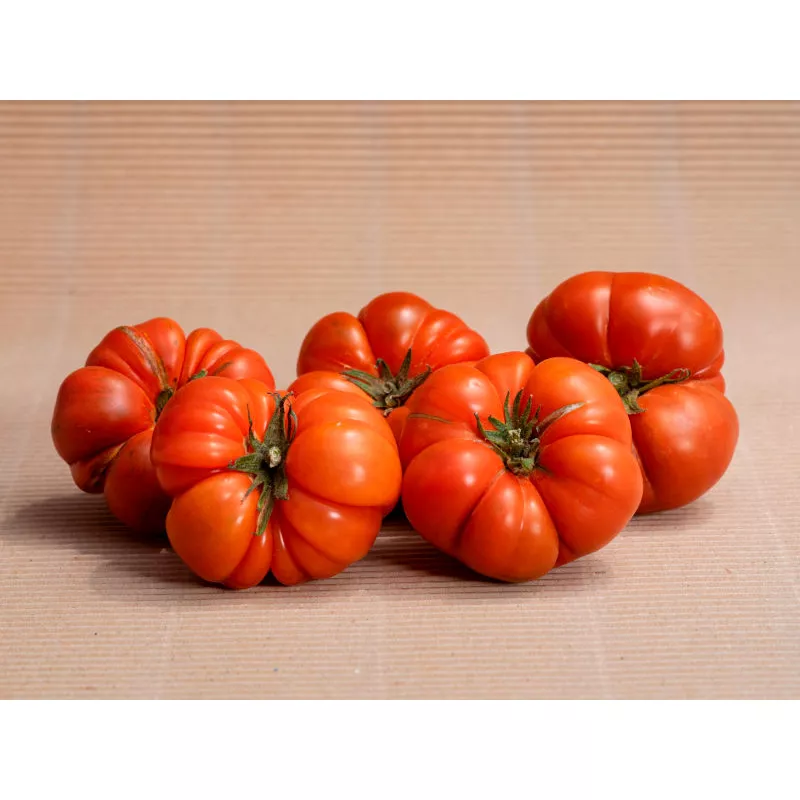
Tomatoes RAF
Origin
‘RAF’ means “Resistant to Fusarium”. It was developed in France by the company Clause around 1961 through selection from the Marmande type and other American lines with resistance to the Fusarium fungus. It was officially registered as a variety in 1967. It is not an F1 hybrid, but a field variety derived from artificial selection. Although historically associated with the Vega de Almería in Spain, it does not come from traditional Valencian collections of IVIA or COMAV but it is commercially grown in the Comunitat Valenciana.
Characteristics
Semi-determinate or determinate plant, medium vigor; robust foliage and normal leaves; typical tomato flowers except for the fruit’s sensitivity to excess moisture on the shoulders. Fruit of medium size, weight between 100 and 250 g, rounded to slightly flattened shape, with deep ribs (“ribbed”) and a very marked green neck that may persist when ripening at the base. Skin thin and somewhat delicate. Dense, fleshy, juicy pulp, with small seeds. Exterior color intense green with dark shoulders; ripening progresses from the inside to the outside. Sweet flavor with a good balance of acidity; in analysis it reaches approximately 6-9 ºBrix at the optimal ripening point.
Harvest time
It is grown mainly in winter and early spring in Almería, although its commercial availability can extend if grown under plastic. In the Comunitat Valenciana the optimal window coincides with that winter-spring season. It does not tolerate being left on the plant for too long after full ripening because quality (texture and flavor) deteriorates quickly after reaching the “turning” point (green-orange). It is better to harvest when the red coloration begins at the base, just at the onset of ripening, to maximize flavor.
Culinary uses
Suitable mainly for fresh consumption: salads, gazpachos, salmorejos, simple dressings with oil and salt. It is not suitable for stews or cooking that requires prolonged cooking since it loses part of its fine texture. It is valued for its aromatic flavor, sweetness, and crunchy texture. In Mediterranean cuisine it is usually eaten simply sliced with extra virgin olive oil. It is not usually used for large-scale industrial processing, but it can be used for artisanal juices or gourmet products.
Agronomic notes
Moderate-low productivity per plant; the plant yields about 4-5 kg under optimal conditions, much less than commercial hybrid varieties. Marked varietal alternation if good soil and irrigation conditions are not maintained. Sensitive to cold and excess moisture, especially on the shoulders of the fruit; common pests such as whitefly, aphid and fungal diseases; it exhibits resistance to Fusarium (Fusarium oxysporum) in roots. Robust rootstock pattern if greater resistance to diseased soil is desired. Limited postharvest: fruit fragility requires careful handling; short storage, best kept fresh in the short term, without prolonged storage chambers due to skin sensitivity and rapid loss of aroma and texture.
Harvest window
In season · Ends in 283 days 15 aug → 30 junIndicative dates; may vary depending on harvest and weather.
