Select shipping country

In order to provide you with the final prices of the products (including taxes and transport costs), we need you to select the country of destination from the following list of countries.

On 1 July 2021 the One-Stop Shop (OSS) directive for e-commerce came into force. This will require us to apply the V.A.T. rate corresponding to the destination country of the shipment.

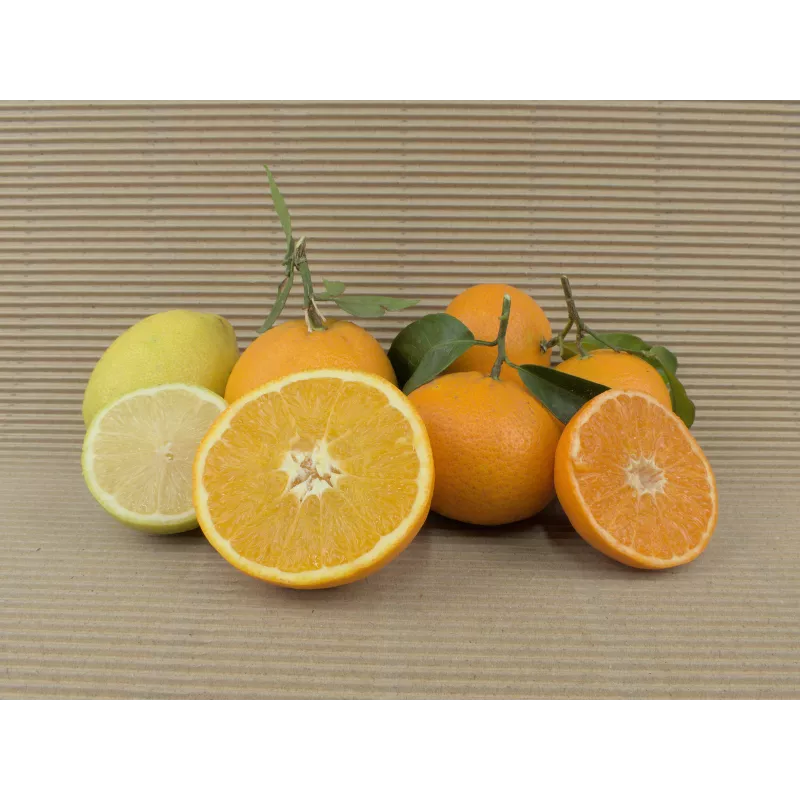
Mixed Box 15 kg (10 kg oranges + 3 kg mandarins + 2 kg lemons)

Navelina/Orogròs/Eureka Conventional farming
62.50 € 4.17 €/kg VAT and shipping to Netherlands incl.

We usually start harvesting in November, depending on ripeness.

Want to know when oranges and lemons are back?

Oranges Navelina

Origin

The Navelina variety is a spontaneous mutation of the Washington Navel orange originating in Riverside (California) around 1910, initially known as Smith’s Early Navel. In 1933 it was sent as plant material to the IVIA in the Valencian Community, where it was given the name Navelina because of its slightly smaller size than Washington Navel. Its commercial propagation began in the 1960s, with significant expansion during the 1970s, establishing itself as one of the most widely cultivated Navel varieties in Spain.

Characteristics

Vigorous tree, rather compact in habit, thornless and with dark-colored foliage. It presents pollen-free flowers, typical of the Navel group. The fruit is round, slightly oblate, with a diameter between 73-78 mm, and a diameter/height ratio close to 0.98. Average weight ranges between 200-220 g. Medium-thickness peel (3.5-4.5 mm), intense orange color, color index 18. Very juicy pulp, seedless, with a typical number of segments between 10-12. As for internal quality, the Brix degrees are around 10-12º, with moderate acidity (around 0.9-1.0 % citric acid), juice content between 50-54 % of the fruit.

Harvest period

In the Valencian Community, harvesting begins approximately between October 20 and 30 and extends until the end of January. It is early-ripening compared to other Navel varieties, reaching the market earlier. It has a good ability to remain on the tree without losing quality during the first half of the harvest window; its optimal fresh-market window is in November and December, when it reaches its maximum internal quality and external color.

Culinary uses

It is mainly intended for fresh consumption, as a table orange, due to its ease of peeling, sweet flavor and seedless pulp. It can also be used for juice, although it is not its preferred use for the industry, since other varieties provide higher juice yield. In Mediterranean cuisine it is enjoyed as is, in fruit salads, salads or side dishes where its citrus aroma is appreciated; combinations with honey, fresh herbs (mint, thyme) or mild cheese are common.

Agronomic notes

High productivity and early bearing. It shows alternation between seasons, although moderate. Good tolerance to calcareous soils and iron chlorosis, and also some resistance to cold compared with other Navel varieties. Sensitive to rind blemish; peduncle attachment is good. It is recommended to graft onto rootstocks such as Carrizo citrange or C-35, which provide a good balance between vigor and fruit quality. Postharvest behavior is good if it is kept at temperatures between 6-8 °C; there are limitations in prolonged storage, since the flavor may change and delayed bitterness appears if the juice is used after a long storage period.

Mandarins Orogròs

Origin

Orogrós is a spontaneous mutation of the Oronules clementine variety, discovered by Vicente Arnau Martínez in La Vall d’Uixó, Castellón (Spain). It is registered as AVASA-PRI 26 with community plant protection (EU decision 36431) granted on October 21, 2013. No main synonyms are documented beyond its commercial name, although some records closely link it to mutations of the Oronules group and other early varieties from the IVIA program.

Characteristics

The tree has low to moderate vigor, without thorns, small, narrow leaves, and a high foliage density. A tendency toward multibud galls is observed, especially in seedlings and when the trunk is exposed to the sun. The fruit has a slightly flattened oblate shape, a diameter between 55-60 mm, and a typical weight of 90-100 g. Moderately thick peel (≈2.3 mm), intense reddish-orange color with an external chromatic index around 21-24. Orange-colored pulp, practically no seeds except with cross-pollination, juicy texture, and balanced sugar/acid flavor. °Brix between 12-15 %, acidity between 1.6-1.2 % (or titratable 1.35-0.95 g/L depending on context). Representative juice content around 50-58 % of the fruit weight.

Harvest time

In the Comunitat Valenciana, harvest typically takes place from September 20 to the end of October, although in some areas with a temperate climate it may extend to early November. It is an extra-early variety compared with Oronules, ripening about ten to fifteen days earlier. The fruit maintains good quality if it remains on the tree within the optimal external ripeness period, but delaying harvest excessively can cause puffing problems. The fresh marketing window is very early, ideal for introducing the clementine season.

Culinary uses

Mainly suitable for fresh consumption due to its sweet flavor with slight acidity, juicy pulp, and easy peeling. It can also be used for mild juice because of its good juice content, although its scarce presence of seeds and good texture make it preferable for table use. In Mediterranean cuisine it is eaten as is or incorporated into salads and citrus desserts, where its balanced flavor and bright color add aesthetic and organoleptic value.

Agronomic notes

High productivity from the first years, with early bearing. Moderate alternate bearing, although less pronounced than in other similar mutations. Sensitive to sunburn on fruit and to puffing if harvest is delayed. Requires vigorous rootstocks for grafting since the mother tree has low vigor and to avoid deformities caused by multibuds. It has no thorns, which facilitates work. In postharvest it performs well if degreening is applied; it tolerates cold storage without significant quality losses if the appropriate period is maintained. Limitations include the reduced tree lifespan due to structural problems from galls and the need for thinning and trunk protection to minimize defects.

Lemons Eureka

Origin

Variety selected in California around 1858 from seeds imported from Italian lemon (possibly Lunario), commercially introduced by Thomas A. Garey and Andrew Boyle in Los Angeles; clones such as Frost Eureka, Taylor and Allen exist. It is one of the two main lemon varieties recognized in the IVIA Germplasm Bank, with identifiers such as Eureka Allen and Eureka Frost, also used as a garden and orchard variety.

Characteristics

Medium to high vigor tree, with an open habit, a rather spreading canopy and fewer thorns than the Lisbon or Fino variety; medium to large leaf, with a crenate margin and a strong lemon smell when broken. Oval or oblong fruit, with a modest apical nipple and no neck in the peduncle area; skin relatively medium to thick (5-6 mm), yellow color at maturity; green-yellow flesh; juicy, with juice content of 40-45 % of the fruit weight; variable seeds, between 8 and 13 per fruit, depending on temperature during flowering; pronounced acidic flavor, strong classic lemon organoleptic profile.

Harvest time

In the Comunitat Valenciana the harvest for Eureka is approximately between October 10 and February 20; harvesting can begin with fruit still greenish, but when it has adequate size and sufficient juice percentage; the fruit can remain on the tree for a reasonable time without severe loss of quality if maturity and storage conditions are controlled.

Culinary uses

Variety suitable both for fresh consumption and for juice due to its high juice content and acidity; it is also used for culinary preparations that require pronounced lemon aroma such as dressings, seasonings, preserves or traditional conserves; in Mediterranean gastronomy it is incorporated into fish dishes, salads, citrus sauces, pastries and to flavor liqueurs; the zest of its peel provides essential oils with sufficient intensity for delicate uses.

Agronomic notes

It enters production early and has high productivity; a reflowering variety, with floral flushes several times a year, although the optimal commercial yield occurs between autumn-winter; moderate sensitivity to cold, less than Lisbon but with damage in very cold climates; suffers from sunburn and fruit defects if grown in very sunny exposures; postharvest is well tolerated if kept between 3-7 °C, with risk of physiological disorders such as peteca if temperatures are higher; recommended rootstock for local adaptation and to avoid chlorosis, and its longevity is lower than other varieties; commercial limitations include seed and size variability depending on the climate and the clone used.

Conventional farming

These fruits come from conventional farming, which means they may have received conventional treatments during their production. Once harvested, they are only cleaned with a cloth before being marketed. No waxes, fungicides, or other preservatives are added to them. The treatments applied by our farmers exclusively use products authorized by the EU. Nevertheless, a significant portion of the fruits we serve comes from orchards that have not received any pesticide treatments.

62.50 €